
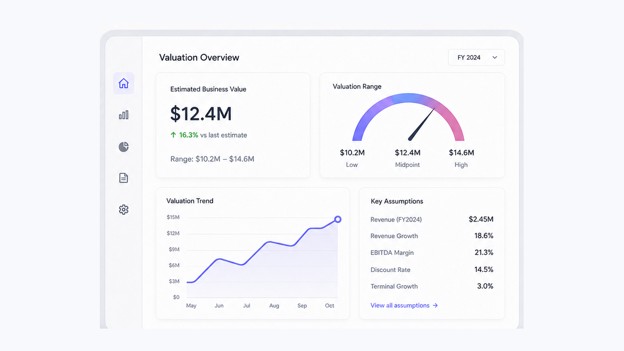
The right business valuation software comes down to three questions:
- which valuation methods it uses
- whether you get a one-time report or ongoing access
- whether it’s built for finance professionals or for a business owner without a financial background.
Get those three answers, and the right choice for your situation becomes obvious.
Most founders and SME owners don’t ask these questions upfront. They search “business valuation software,” pick whatever ranks first, and find out later that what they bought doesn’t match what they needed – a report for one investor meeting versus a working model they can update all year.
Table of Contents
Which Valuation Methods Does it Actually Use?
A single valuation method, just a multiple, or just a discounted cash flow (DCF), gives you one angle on a number that has several defensible answers. Most credible platforms in this category use a weighted combination of methods. That’s a reasonable standard; what varies is which methods, and how much control you have over the assumptions feeding them.
VedaOne runs a live DCF alongside market-multiple valuation, built on assumptions you can see and adjust – industry, business model, size, and location all feed into what the AI suggests, and you can override any of it.
Do You Need a Report, or a Working Model?
This is the question most buyers skip, and it’s the one that matters most. Some valuation platforms, Equidam is a well-known example, are built around producing a single, weighted valuation report, typically valid for around 12 months from purchase. That’s genuinely useful if you have one specific event coming up, like a funding round, and need a defensible number for that moment.
It’s a different tool for a different job if what you need is something that updates as your business does, after a new hire, a pricing change, a slower quarter, without paying for or requesting a new report each time. VedaOne works as a live financial model – change an assumption, and your valuation, P&L, and cash flow all update together, for as long as your subscription is active.
Neither approach is wrong. They solve different problems and know which one you have is the real decision.
Who is it Actually Built For?
Some valuation tools assume you already know what a discount rate or a terminal value is. Others are built so a business owner with no financial background can get a credible number without translating finance jargon first. VedaOne is built for the second group by default, while still giving finance professionals and advisors full visibility into the methodology underneath – the same tool works whether you’re a first-time founder or consultant running valuations for multiple clients.
What this Means For Choosing
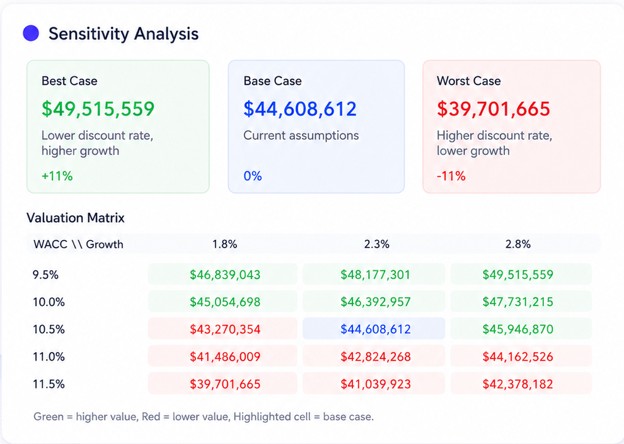
If you need one investor-ready number for one upcoming event and won’t need to revisit it, a report-based tool can do that job well. If you want an ongoing view of what your business is worth as it changes, tied to the same model as your financial statements and forecasts, not a separate exercise, that’s what VedaOne is built for. It’s worth being honest with yourself about which situation you’re actually in before you pay for either.
Start with VedaOne’s free AI valuation tool to see where your business stands. No credit card is required.
Frequently Asked Question
DCF (discounted cash flow) values a business based on projected future cash flows discounted to today’s value. Market multiple valuations compare your business to similar companies using metrics like revenue or earnings multiples. Using both together, rather than relying on just one, gives a more balanced view. Which is why VedaOne runs them side by side rather than picking one.
It depends on your situation. A one-time report suits a single event, like preparing for one funding round. Ongoing access suits businesses that want their valuation to stay current as assumptions change – useful for continuous planning, not just a single pitch.
Not with tools built for non-finance users. VedaOne is designed so a business owner can generate a credible valuation without first learning financial terminology, while still showing the full methodology for anyone who wants to go deeper.
Platforms like Equidam typically produce a single weighted valuation report[GU4.1], valid for a set period, aimed at a specific fundraising moment. VedaOne is an ongoing subscription platform – your valuation is one connected part of a live financial model that includes your P&L, balance sheet, and cash flow, updating together as your inputs change.
An AI-assisted valuation is a strong starting point for decision-making, benchmarked against industry data and built on transparent, editable assumptions – but it’s decision-support, not a guaranteed outcome. Treat it the way you’d treat any valuation – as a well-reasoned estimate to guide a conversation, not a certified figure.